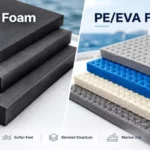
Both EVA and PE/EVA can make good boat flooring. The better choice is the grade that suits your boat, exposure conditions, and fabrication requirements—not whichever label sounds more advanced.
For a boat owner, that usually means comfortable footing, an appealing finish, and manageable cleaning. For an installer or boatbuilder, it also means sheets that route cleanly, hold their dimensions, and behave consistently across deliveries. Those qualities come from the foam formulation, density, hardness, closed-cell structure, and production process. Thickness and the adhesive system matter, too. Below, we look at where EVA and PE/EVA can differ in practice, why similar-looking samples can perform differently, and what makes a useful purchasing comparison.
What Are EVA and PE/EVA Foams?
EVA is ethylene-vinyl acetate, a copolymer used to make flexible foam. Marine flooring grades are typically expanded and crosslinked, with pigments and other ingredients selected for their intended use. In a commercial description, “pure EVA” does not mean a finished sheet contains nothing but EVA resin. Additives remain part of foam manufacturing.
PE/EVA combines polyethylene and EVA in a formulated blend. The name gives no fixed mixing ratio, and the resulting foam is different from pure PE foam. Changing the polymer balance can alter firmness, recovery, and processing behaviour, but the rest of the recipe still matters.
Both material families can have a closed-cell structure: gas pockets are largely separated rather than interconnected. That structure comes from how the foam is made. Zotefoams’ AZOTE range, for example, includes closed-cell foams made from different polymer bases. Similar density, hardness, and surface finishes can therefore make EVA and PE/EVA samples feel surprisingly alike. Different recipes can target the same firmness, so a squeeze test reveals personal preference more readily than wear resistance or thermal stability.
How Do EVA and PE/EVA Foams Compare in Marine Conditions?
A deck combines sunlight, water, repeated loading, and temperature changes. The table below shows where a blend may change behaviour—and which evidence is more useful than the material name.
Comparison factor
EVA vs. PE/EVA in practice
Useful evidence
Comfort & cushioning
EVA grades vary from soft to firm; PE blending can change support and recovery. Thickness and cell structure also affect feel.
Matched-thickness samples; compression and recovery results.
Wear & tear resistance
Abrasion and tearing are separate properties. A blend can change either; density, crosslinking, and surface finish also contribute.
Abrasion results and tear strength under matching methods.
UV & weather resistance
Both need suitable outdoor formulations. Sunlight and heat can cause fading, hardening, or distortion; adding PE alone establishes no advantage.
Weathering cycle, colour tested, and measured property changes.
Water resistance
Both can have low water uptake when cells remain closed. Blend composition alone does not establish absorption.
Water-absorption results with immersion time and temperature.
Dimensional stability
Either can move with heat or residual manufacturing stress. Polymer balance, crosslinking, and conditioning affect shrinkage.
Length and width change after defined heat exposure.
CNC machinability
Both can route cleanly. Blending can change firmness; sheet consistency, tooling, and layer bonding determine detail quality.
A routed sample using production tooling and settings.
Cost
Neither label fixes the price. Resin recipe, density, finish, lamination, adhesive, and order volume influence the quotation.
An itemised quote against the same finished specification.
These are grade-dependent differences, not a universal ranking of the two material families.
Weathering hours also need context. A long exposure with little explanation says less than a report showing the cycle, temperature, and changes in colour or mechanical properties. Laboratory hours do not translate directly into a promised number of years on a boat.
Which Foam Should You Choose for Your Boat Flooring Project?
For Recreational Boat Owners
Start with how the boat lives. Occasional weekend use under cover is different from daily exposure at an open berth. Barefoot comfort, colour, surface texture, cleaning, and budget usually matter more than the blend label. The softest sample may feel pleasant immediately; a firmer grade may provide the support you prefer during longer periods standing. Surface texture deserves attention alongside cushioning because it affects footing and how readily dirt collects. Deep decorative grooves can hold sand even when the foam absorbs little water; the cleaning routine follows the finished surface as well as the material.
For Marine Flooring Installers
A clean routed edge is only part of a successful job. Panels also need to retain their intended shape after machining and bond reliably to the deck. Thickness variation, inconsistent hardness, or weak lamination can turn a familiar toolpath into an uneven result. Batch consistency reduces setup changes, while a suitable backing adhesive helps control installation and rework costs.
For Boat Builders and OEM Buyers
Repeat orders put the emphasis on agreed specifications, production capacity, delivery planning, and traceable test information. Colour and hardness variation become especially visible when panels from different batches meet on the same deck. Purchase cost matters alongside the risk of rejected or mismatched parts.
The right choice follows the project requirements and demonstrated material performance. There is no single EVA or PE/EVA grade that suits every boat.
Not Sure Which Foam Fits Your Project?
Choosing between EVA and PE/EVA foam? Share your boat flooring application, preferred thickness, and project requirements with YSDEK. Our team can help you review suitable material options.
Why Do Foam Density, Hardness, and Cell Structure Matter?
Two sheets marked 6 mm can have very different prices because thickness describes only one part of the product.
Foam Density
Density, usually expressed in kg/m³, describes mass per unit volume. At equal thickness and area, a denser sheet weighs more. Within a comparable formulation, density can affect support and mechanical strength, but higher density does not automatically improve softness, UV resistance, or overall service life. Measured density data reveals more about the supplied grade than a description such as “high density.”
Shore Hardness
Hardness describes resistance to indentation, not weight per unit volume. Polymer formulation and cell structure help explain why foams of similar density can feel different. A hardness number needs its Shore scale and test conditions: instrument, specimen thickness, conditioning, and reading time. Numbers measured on different scales are not interchangeable.
Closed-Cell Structure and Dimensional Stability
Closed cells restrict water movement through the foam. Cell uniformity, crosslinking, and manufacturing conditions also influence how a sheet responds to heat and loading. A neat cross-section is useful for spotting obvious irregularities, but it cannot reveal UV stabilisation or residual stresses. That is why a photograph alone tells little about expected service life.
What Matters for CNC Cutting, Adhesive Bonding, and Installation?
CNC Cutting & Routing
Suitable grades of both materials can be cut, grooved, and engraved with logos. Softer foam may compress under the cutter; tool sharpness, feed rate, spindle speed, and depth of cut affect edge quality. Density and thickness consistency influence repeatability. With multilayer sheets, routing also exposes the layer bond: clean surface detail is little comfort if the layers separate.
Adhesive Bonding
The backing is a system of adhesive, foam surface, and deck substrate. Gelcoat, painted aluminium, and other finishes present different bonding conditions. 3M’s explanation of low-surface-energy plastics includes PE and EVA among materials that can be challenging to bond. A compatible adhesive may work across several grades, but a tacky hand sample says little about performance after heat and water exposure. A bonding trial on the intended deck finish is more informative than one on an unrelated workshop offcut.
Installation
Accurate templates and planned panel gaps help accommodate fittings and expected movement without forcing panels into place. Clean, dry surfaces and the adhesive supplier’s application temperature range support proper contact and bond development. YSDEK’s custom boat flooring process connects the layout, material options, and machining stages; those decisions work best together.
How Can Buyers Evaluate Samples and Compare Supplier Quotes?
Request Comparable Material Samples
A useful comparison keeps thickness, density, hardness specification, texture, intended application, and test conditions as close as practical. Otherwise, a soft, low-density EVA sheet may be judged against a firm PE/EVA grade, and a grade difference gets mistaken for a polymer difference. A full-thickness routed piece reveals more than a small colour swatch. The trial piece can include your narrowest groove, smallest lettering, and a finished edge. That gives both parties a concrete reference for machining quality, rather than leaving “clean cutting” open to interpretation.
Check the Technical Specifications
A workable specification covers:
Material type and disclosable formulation details; density in kg/m³; hardness with its Shore scale; thickness and tolerance; water absorption; UV/weathering conditions and results; dimensional stability; adhesive options; and batch consistency information.
“Marine grade” is a product description, not evidence that every property has been tested. The useful details are the method, specimen conditions, result, and acceptable range. An approved reference sample, agreed colour tolerance, and batch identification give repeat orders a clearer basis than photographs or a generic data sheet alone.
Compare the Total Project Cost
Price per square metre leaves out CNC work, adhesive, nesting yield, minimum order quantity, packaging, freight, and rejected panels or rework. Sheet dimensions matter because awkward offcuts raise the cost of each usable part. A lower sheet price can disappear quickly when material utilisation falls. There is no reliable fixed price premium for PE/EVA over EVA; the finished specification and order conditions determine whether two quotations are comparable.
Compare EVA and PE/EVA Options for Your Project
Planning a custom boat flooring or wholesale order? Send YSDEK your material specifications, required thickness, dimensions, quantity, and design files. We can review your requirements and discuss suitable options and quotation details.
Useful enquiry details: material preference, thickness, quantity, application, drawing availability, and contact information.
Conclusion: Choosing the Right Foam for Your Boat Flooring
Choose EVA or PE/EVA according to the grade’s demonstrated performance and the demands of your project. Both can suit marine flooring; neither name establishes better durability, comfort, or machining quality on its own. A useful decision comes from samples matched to the intended thickness and finish, performance results relevant to the exposure, and a clear specification for repeat orders. For installers, boatbuilders, and wholesale buyers, consistent batches matter as much as the first approved sample. YSDEK’s custom material and CNC options provide a starting point for discussing how the proposed foam and adhesive system will work on your deck.
FAQ About EVA and PE/EVA
Can EVA and PE/EVA foam both be CNC-routed for custom boat flooring?
Yes. Suitable grades of both can be cut, grooved, and logo-engraved. Hardness, density, thickness consistency, layer bonding, and cutter settings affect the result. A trial using the proposed production material and toolpath shows whether fine details remain clean and finished panels hold their dimensions before a larger run begins.
What if a supplier cannot disclose the exact PE/EVA blend ratio?
The ratio may be proprietary. A material-family declaration, agreed density and hardness ranges, dimensional tolerances, and relevant test results still provide a basis for purchasing. Where formulation details remain confidential, testing representative samples and defining batch acceptance criteria reduce the risk of receiving a different-performing material later.
Does closed-cell EVA or PE/EVA foam make a boat deck waterproof?
No. Closed-cell foam generally absorbs little water, but that does not make the installed flooring a waterproof membrane. Water can reach beneath panels through seams, edges, or poorly bonded areas. The foam’s water absorption and the installation system’s ability to exclude water are separate questions.
Do EVA and PE/EVA boat flooring require different adhesives?
They may use similar pressure-sensitive adhesive systems. Suitability depends on the particular foam surface and deck finish, plus service conditions. Peel and shear testing, including relevant wet and heat-aged conditions, helps assess compatibility. The adhesive supplier’s preparation, application temperature, pressure, and bond-development requirements remain part of the specification.